


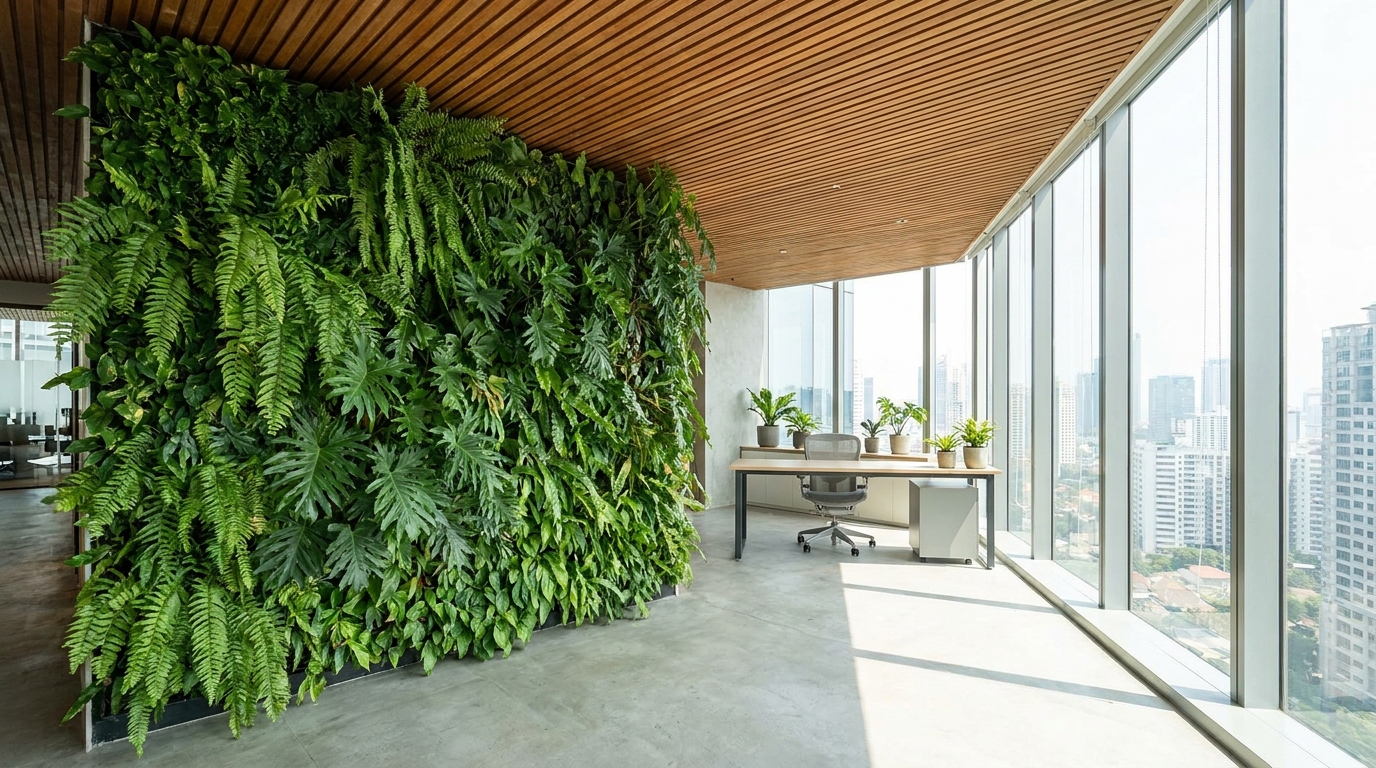
Walk into a newly fitted office in SCBD or TB Simatupang lately and you'll probably see a green wall in the lobby, a few timber slats on the ceiling, and clusters of plants near the windows. Biophilic design has gone from a buzzword to something clients now ask for by name.
The instinct is right. Jakarta is a city of concrete towers and bad air, and people spend most of their waking hours inside them. Bringing nature into the office isn't just a look. It's a response to a real problem. The catch is that most biophilic features fail within a year here, not because the idea is wrong, but because nobody planned for who waters the wall or whether the plant can survive in a corner with no daylight.
What biophilic office design actually means
Biophilic design is the practice of connecting people to nature inside a built space. In an office that usually means live plants, natural light, real timber and stone, water features, and views of greenery. The goal is to make a workspace feel less like a sealed box and more like somewhere a human body wants to be.
There's real research behind it. A study from the University of Exeter found employees were around 15% more productive in offices with plants compared to bare, lean ones. Other workplace studies link greenery and natural light to lower stress and less fatigue, with some reporting stress and anxiety down by roughly a third.
For Jakarta there's a more specific reason. A lot of buildings here have genuinely poor indoor air. A 2024 study of Jakarta office workers found PM2.5 levels were strongly tied to sick building syndrome, the cluster of headaches, coughing, irritated eyes, and fatigue that drains a workforce without anyone knowing why. In that study, headache affected nearly half the workers surveyed. Plants, better ventilation, and proper daylight are part of how you fight that.
Why it works in Jakarta specifically
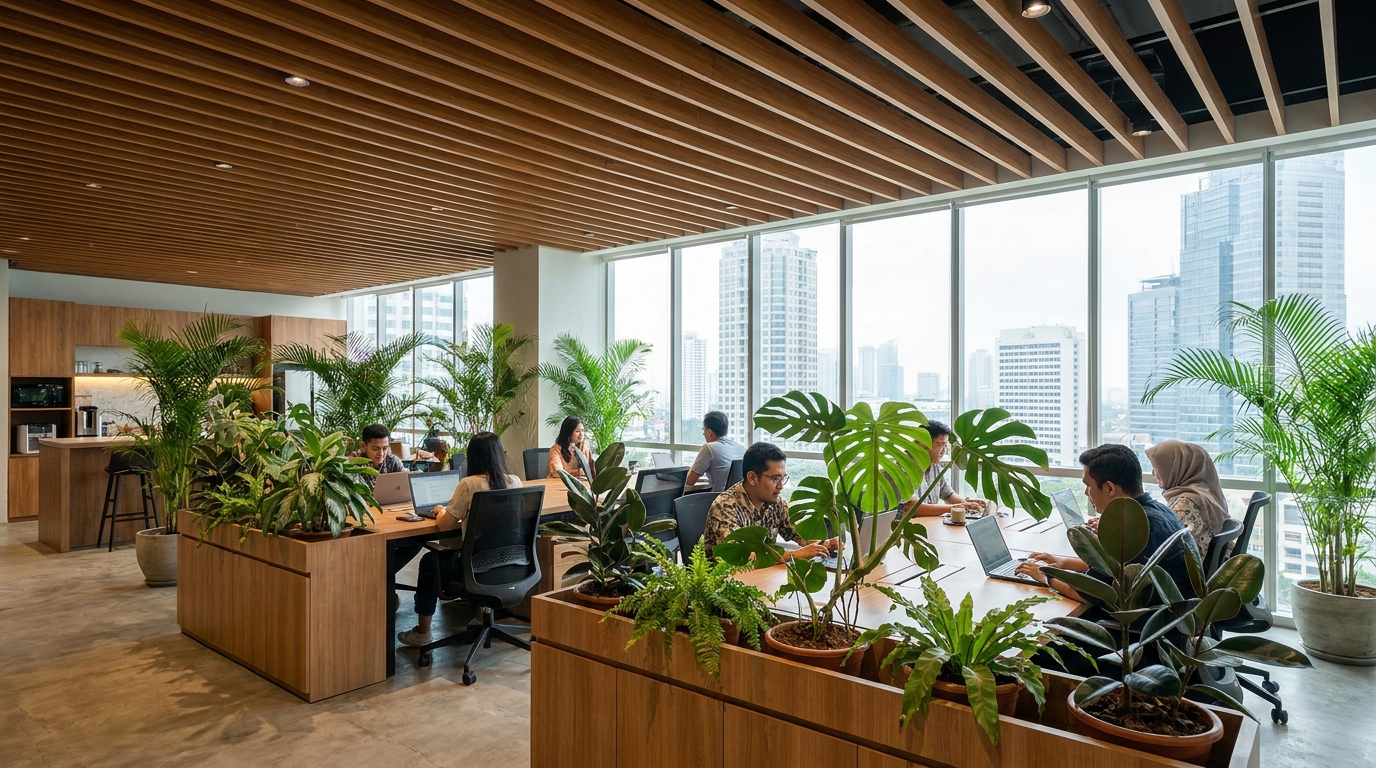
Most Jakarta offices are sealed, air-conditioned, and recirculating the same air all day. Add the city's outdoor pollution leaking in through every door, plus mold in old ventilation ducts, and you get the conditions for sick building syndrome. We've measured air quality in buildings where the numbers explained exactly why staff kept calling in sick.
Greenery helps in two ways. Some plants pull common indoor pollutants like formaldehyde and benzene out of the air, the stuff that off-gasses from new carpet, paint, and cheap furniture. And the simple presence of plants and daylight changes how a space feels, which shows up in mood and focus.
The other Jakarta-specific point is heat and light. We have strong, consistent daylight most of the year. A biophilic design that uses that daylight well, through good window planning and glazing, cuts your lighting bill and gives plants what they need to actually live. The same climate that destroys the wrong materials is generous to the right plants.
The features that survive, and the ones that don't
This is where logic has to step in front of the mood board. A vertical garden looks spectacular in the render and becomes a brown, patchy mess by month six if nobody answered three boring questions during design: how does it get water, where does that water drain, and who maintains it after handover.
Green walls are the most common failure. A living wall needs an irrigation system, a drainage path, and a maintenance contract. Put one in a dark corner with no daylight and it dies slowly no matter how good the plants were on day one. We've seen feature walls that cost tens of millions of rupiah turn into a wall of dead twigs because the design treated it as decoration instead of a living system that needs upkeep.
Loose potted plants are the opposite. They're cheap, they're flexible, and you can match the plant to the spot. Snake plants and pothos handle low light and irregular watering, which is exactly what a real office delivers. They survive the intern who forgets to water them for two weeks. For most spaces, a smart arrangement of hardy potted plants does more for less risk than a single dramatic green wall.
Timber and rattan are the warm, natural touch everyone wants in 2026. They also react to moisture. Untreated or poorly sealed wood in a humid Jakarta interior will swell, stain, and grow fungus. Used indoors with proper sealing and away from constant AC condensation, timber is fine. Used as an exterior facade in this climate, it rots. The look is right; the execution has to respect 75 to 95% humidity.
Thinking about a green wall or a planted office? Tell us your floor plan and where the daylight falls, and we'll tell you honestly what will live and what will be dead by Lebaran.
What it costs and how to plan it
Biophilic design doesn't have to be expensive, but it does have to be budgeted honestly. As a rough Jakarta benchmark, a basic commercial fit-out runs around 3 million IDR per sqm, acceptable quality sits around 5 to 6 million, and premium work reaches roughly 11 million. Plants and natural materials sit on top of that, and the real cost isn't the install, it's the maintenance.
A wall of loose potted plants might cost a few million rupiah and almost nothing to keep alive. A proper living green wall can run tens of millions to build and needs a monthly maintenance budget on top, because someone has to check the irrigation, replace dead plants, and clean the drainage. If you're not willing to pay for that upkeep, don't build the wall. A field of pots will make you happier and won't embarrass you in front of clients.
The bigger planning point is to design biophilic features in from the start, not bolt them on at the end. Daylight, planting zones, and irrigation lines are cheap to plan and expensive to retrofit. This is the same logic behind any tight office layout in Jakarta: every element has to earn its place and survive how the space is actually used. If you want to see where biophilic fits among this year's broader directions, it's one of the more durable commercial design trends for 2026.
How to do it without getting burned
Start with the why, not the wall. If your goal is cleaner air and a calmer workforce, the answer might be better ventilation and a dozen well-placed plants, not an Instagram feature that needs a gardener on retainer. A good designer asks what you're trying to achieve before showing you anything green.
Then check the maintenance plan before you sign. Ask who waters the plants, who services the irrigation, and what happens when something dies. If the proposal has a stunning green wall and no line item for maintaining it, that's a gap that becomes your problem in six months. A firm that's built living spaces before will raise these questions first; the kind of practical scrutiny we'd flag when choosing an office design firm in Jakarta.
Done properly, biophilic design is one of the few trends that pays you back in real ways: cleaner air, fewer sick days, a space people actually want to come to. Done as decoration, it's a maintenance bill attached to a dead wall. The difference is entirely in the planning.
Want an office that's genuinely greener, not just green on opening day? With 700+ completed commercial projects across Jakarta and Tangerang, we design biophilic spaces for how they survive the climate and the cleaning schedule.