



A signed contract feels like protection. In Jakarta, it often is not. Indonesian commercial fit-out disputes rarely come down to which party was right. They come down to which party documented the work properly and which party left gaps the other side could walk through.
Legal protection in a design and build contract is not about adding more pages. It is about closing the specific holes Indonesian firms know how to exploit. Here is what to lock down before you sign, and what to keep doing after the contractor moves on site.
Make the contract enforceable under Indonesian law
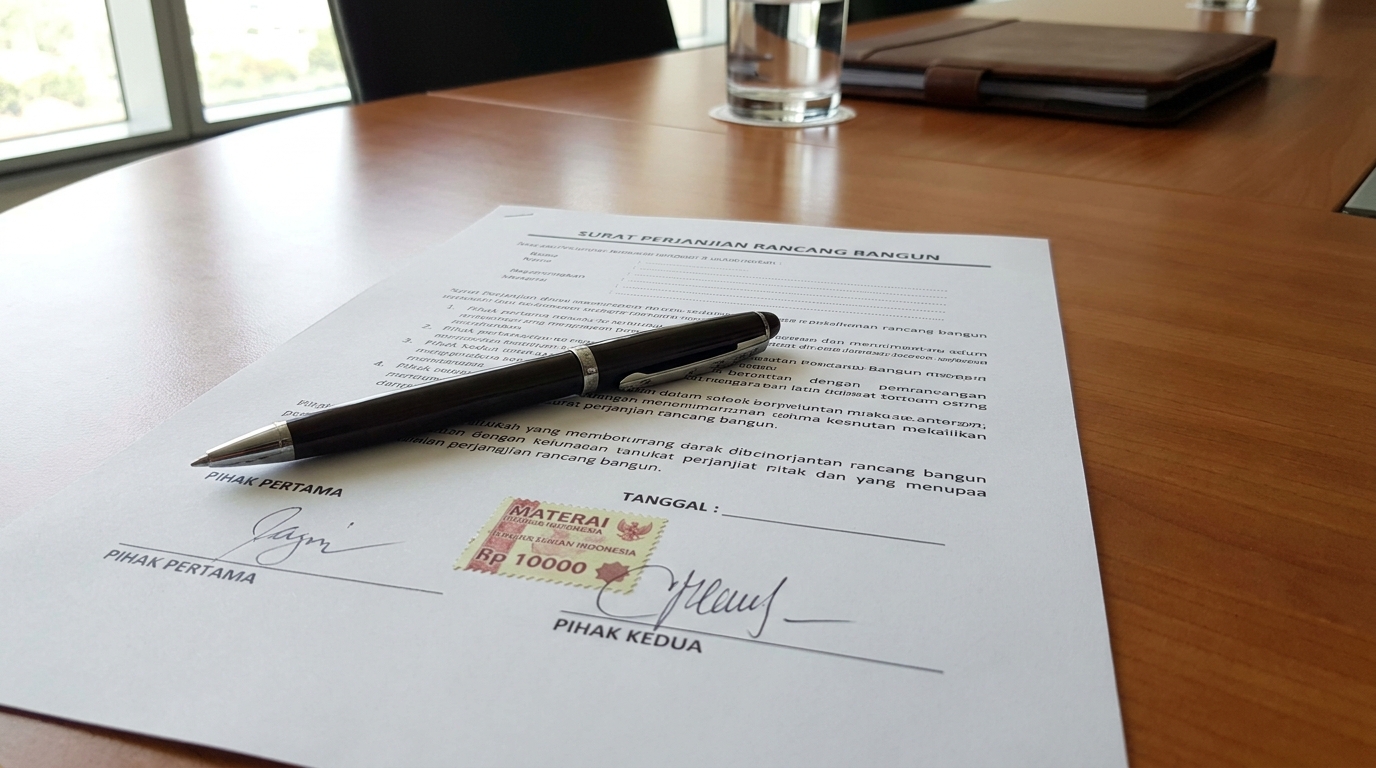
The first protection is making sure the document you signed is the document a court or arbitrator will actually enforce.
Indonesian contracts must comply with Articles 1320 and 1338 of the Civil Code. Both parties need legal capacity, mutual consent, a clear object (the scope of work), and a lawful cause. If any one of these is missing or vague, the contract can be challenged. The most common weakness is the object: a contract that says "interior fit-out works" without an attached bill of quantities is not a clear object. Attach the BoQ as an annex and reference it by name in the contract body.
Use a duty stamp (materai Rp 10.000) on every original signed copy. An unstamped contract is still valid between parties, but it cannot be submitted as evidence in court until the stamp duty is paid retroactively, often with penalties. Just stamp it from the start.
Sign in Bahasa Indonesia, or in dual language with Bahasa as the prevailing version. Law No. 24/2009 requires contracts involving Indonesian parties to be in Bahasa Indonesia. An English-only contract with an Indonesian counterparty has been held void in Indonesian courts before. If you need an English version for your own use, agree explicitly that the Bahasa version controls in case of conflict.
Lock the scope so it cannot drift
Most legal disputes in Indonesian fit-outs are not about whether work was done. They are about whether the work that was done matches what was promised. The scope is your weapon and your shield.
Specify every material by brand, model, grade, color code, and quantity. "Premium laminate" gives the contractor a defense. "TACO HPL TH-2841 BS, 1220x2440mm, 150 sheets" does not. The same applies to ironmongery, sanitary ware, lighting fixtures, and electrical components. The line between a clean delivery and a long argument is usually whether the bill of quantities was specific enough to leave no interpretation room.
Put exclusions in a single consolidated section, not scattered across footnotes. Standard exclusions for Indonesian fit-outs include MEP beyond a defined termination point, building permits (IMB or PBG), tenant improvement work belonging to the landlord, IT cabling beyond the rack, and any structural modifications. If something is excluded, it must be named. A contract that says "additional items may be excluded at contractor's discretion" is not a contract you want to sign.
Variation orders need a non-negotiable clause: any change to scope, materials, or quantity must be documented in writing and signed by both parties before the work proceeds. A WhatsApp message is not a variation order. Verbal approval from your project manager is not a variation order. Indonesian arbitration panels routinely throw out claims for "additional work" that lack signed VOs, but they also throw out client refusals to pay for work that was clearly authorized verbally and accepted on site. Putting it in writing protects both directions.
Reviewing a contract right now and unsure what to flag? Send us the draft before you sign.
Use payment structure to keep the contractor accountable
Payment terms are where contracts shift power. Get the structure wrong and you have no recourse. Get it right and the contractor stays motivated until the last day.
The standard payment structure for Jakarta commercial fit-outs is roughly 30% on signing, 30% on material delivery to site, 30% at a defined progress milestone, and 10% on handover. Some firms hold an additional 5% as retention for three months after handover as defect insurance. If a firm asks for 50% or 70% upfront before meaningful site work, that is the lowball-then-disappear pattern, and it is one reason the cheapest quote often becomes the most expensive.
Tie progress payments to verifiable deliverables, not to dates. "Payment upon completion of demolition and partition framing, verified by site inspection report" is enforceable. "Payment after 6 weeks" is not, because the contractor can demand it whether the work is done or not.
Retention money is the single most useful tool you have for the defect liability period. If the contractor holds your final 5% for three to six months after handover, they have a financial reason to come back and fix issues. If they have already collected 100%, they have nothing to lose by ignoring your complaints. Indonesian courts will not force a contractor to honor a defect liability period without retention as the financial hook.
Liquidated damages should be tied to the handover date with a clear daily rate, typically 0.1 to 0.5 percent of the contract value capped at 5 to 10 percent total. Specify what counts as excusable delay (force majeure, owner-caused changes, building management restrictions) and what does not (subcontractor problems, the firm's own scheduling, material procurement they were responsible for). A contract that makes almost everything excusable has no LD clause at all.
Plan for disputes before they happen
The dispute resolution clause is the part nobody reads until it is too late. Read it first.
For Indonesian commercial contracts, the most enforceable choice is BANI (Badan Arbitrase Nasional Indonesia) seated in Jakarta. Arbitration awards are binding, faster than court, and confidential. Avoid contracts that send disputes to obscure arbitration bodies, foreign jurisdictions, or that require mutual agreement to even start a proceeding. If your contract says "disputes shall be resolved amicably between the parties," you have no dispute resolution clause.
Build in a tiered process: first written notice and a 14-day cure period, then mediation, then arbitration. This forces both sides to attempt resolution before a formal proceeding starts, which is faster and cheaper than going straight to BANI for everything.
Include a termination-for-cause clause that does not require court approval. Common cause triggers include failure to start within an agreed number of days, abandonment of the site for more than a defined period (10 to 14 days is typical), repeated quality failures after written notice, or the contractor's insolvency. If your contract only allows termination by mutual agreement, you are trapped with whoever you signed.
Documentation is what wins disputes in Indonesia. From the day work starts, keep a dated log of site visits, decisions made and by whom, photos of work in progress, every signed VO, and every defect flagged with the date you flagged it. When a dispute lands in arbitration two years later, the side with the paper trail wins. The side relying on memory loses, regardless of who was actually right at the time.
If you are walking through a contract and the firm resists specifics, dodges questions about exclusions, or pushes back on retention and LD clauses, that is the answer to whether you should sign. The legal protection a contract gives you is only as strong as the firm's willingness to be held to it.
About to sign a design and build contract in Jakarta? Let us review the clauses with you before you commit.